

Global education monitoring report, 2024/5, Leadership in education: lead for learning
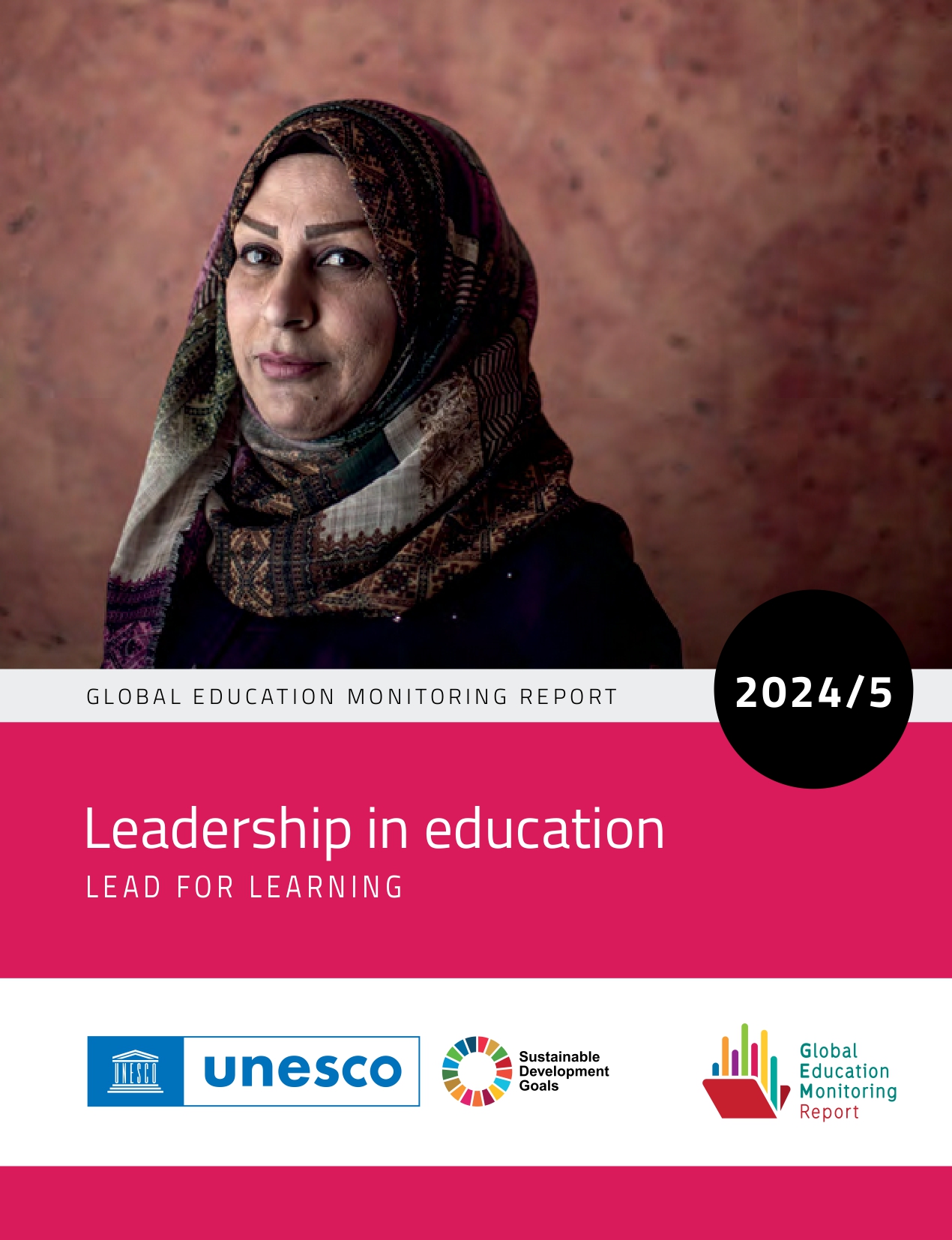
Leadership matters in education. Strong leaders are needed to help institutions, systems and societies change for the better. Strong leaders work in collaboration with other actors towards the same goals. At the school level, they are the principals but also those who surround them, in the school and in the community, in positions of responsibility. At the system level, they are civil servants working as district officers, supervisors or planners. At the societal level, they are political leaders, as well as a very broad range of actors who help shape education goals, from unions and researchers to civil society and the media.
Entitled Lead for learning, this report argues that, in pursuing specific goals, education leaders are more than just managers. They are change agents, who need the time, trust and support to focus on setting a vision and developing the people they serve and work with. The report calls for investment in and empowerment of school and system leaders. There should be fair hiring processes and growth opportunities that recognize the full scope of leaders’ roles. Moreover, leadership works best when it is shared, empowering others to lead as they can within their roles. There is no one leadership style that works. Different contexts, capacities and personalities mean that styles vary, and rightfully so. This, combined with the different goals that each leader is trying to achieve, means that their impact is hard to fully assess. Yet, all research points towards the critical need for strong leaders to continuously improve education quality. School leaders are second only to teachers for transforming student outcomes. Meanwhile, politicians wield huge influence in making equitable and inclusive education a national priority. Supporting this seventh Global Education Monitoring Report is a new series of country profiles on Profiles Enhancing Education Reviews (PEER), an online resource supporting policy dialogue and describing policies and regulations on school principal selection, preparation and development in the world’s education systems. Since wars begin in the minds of men and women, it is in the minds of men and women that the defenses of peace must be constructed.
Entitled Lead for learning, this report argues that, in pursuing specific goals, education leaders are more than just managers. They are change agents, who need the time, trust and support to focus on setting a vision and developing the people they serve and work with. The report calls for investment in and empowerment of school and system leaders. There should be fair hiring processes and growth opportunities that recognize the full scope of leaders’ roles. Moreover, leadership works best when it is shared, empowering others to lead as they can within their roles. There is no one leadership style that works. Different contexts, capacities and personalities mean that styles vary, and rightfully so. This, combined with the different goals that each leader is trying to achieve, means that their impact is hard to fully assess. Yet, all research points towards the critical need for strong leaders to continuously improve education quality. School leaders are second only to teachers for transforming student outcomes. Meanwhile, politicians wield huge influence in making equitable and inclusive education a national priority. Supporting this seventh Global Education Monitoring Report is a new series of country profiles on Profiles Enhancing Education Reviews (PEER), an online resource supporting policy dialogue and describing policies and regulations on school principal selection, preparation and development in the world’s education systems. Since wars begin in the minds of men and women, it is in the minds of men and women that the defenses of peace must be constructed.
Year:
Organisation:
UNESCO; UNESCO International Centre for Technical and Vocational Education and Training
Keywords:
inclusive school leadership, leadership, inclusion in education, inclusion policy, GEM report
Marginalized & Vulnerable group:
All, Indigenous & Minorities, Refugees & Migrants, Socially & Economically excluded groups, Persons with disability
Topic:
System wide approach, Curriculum, Gender inequalities, ICTs, Inclusive Pedagogy & Practices, Language of Instruction, Physical Learning Environment, Educational Staff Professional Development, Violence & Bullying
Level of Education:
Across the education sector, Early Childhood Education, Primary & Secondary, Technical & Vocational Education, Higher Education, Lifelong learning, Non-formal Education
Country/Region:
All, Africa, Arab States, Asia & the Pacific, Europe & North America, Latin America & the Caribbean
Language of Publication:
English