

The right multilingual education policies can unlock learning and inclusion: advocacy brief
It is vital to use home languages as the medium of instruction for promoting inclusion and ensuring the quality
of education. Instruction through home languages for up to six or eight years, alongside the introduction of a
second one, initially as a subject, and later as a parallel medium of instruction, accelerates learning and helps
prevent knowledge gaps. Incorporating children’s first language into formal instruction supports self-esteem and
confidence, reducing grade repetition and dropout rates. Yet policy and implementation challenges remain.
Challenges include limited teacher capacity to use home languages, unavailability of materials in
home languages and community opposition.
of education. Instruction through home languages for up to six or eight years, alongside the introduction of a
second one, initially as a subject, and later as a parallel medium of instruction, accelerates learning and helps
prevent knowledge gaps. Incorporating children’s first language into formal instruction supports self-esteem and
confidence, reducing grade repetition and dropout rates. Yet policy and implementation challenges remain.
Challenges include limited teacher capacity to use home languages, unavailability of materials in
home languages and community opposition.
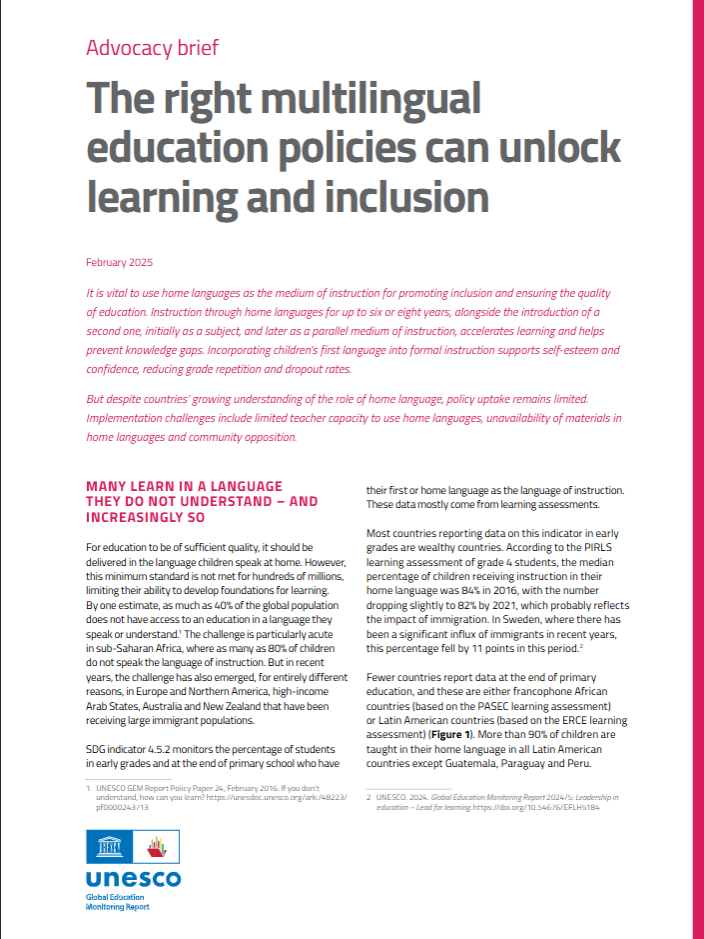
The brief advocates the appropriate multilingual education policies to unlock learning and inclusion. It highlights data with figures and statistics related to the remaining challenges and focusses on different language and education contexts in Africa, the Pacific, the Caucasus and Asia, Soth East- Asia and South Asia, Latin America and the Caribbean.
More
Year:
Organisation:
UNESCO
Keywords:
multilingual education, learning, inclusion policy
Marginalized & Vulnerable group:
All
Topic:
Curriculum, Inclusive Pedagogy & Practices, Language of Instruction
Level of Education:
Across the education sector
Type of Resources:
Research & Policy Papers
Country/Region:
All, Africa, Arab States, Asia & the Pacific, Europe & North America, Latin America & the Caribbean
Language of Publication:
English